
Okay, let’s get all the Don Draper references out of the way.
Do I have countless affairs? No. Do I keep a set of dress shirts at the office for when I go on benders? No. Do I wish I looked like Jon Hamm? Of course, who wouldn’t?
People associate ads with Mad Men, but it’s not a bad transition for this blog. That’s because legendary ad man James Young Webb wrote the still-relevant A Technique for Producing Ideas in 1965. I found that his process is amazingly similar to mine.
(You can read a PDF of the 62-page book here for free. It’s a quick read and well worth it.)
Here are Webb’s five steps to producing an idea, with my thoughts sprinkled in.
1 – Gather All Raw Materials
The most important tool in the print ad process is information.
Start collecting everything you can that’s relevant to the project: ads the company has done in the past, information about the product, audience, competitors, etc.
Is there approved messaging and strategy? A creative brief?
This is when you ask a critical question: What are we trying to accomplish?
What is the point of the ad? Awareness? Attracting a specific audience? A benefit we’re highlighting?
Starting with a blank slate – a vast mental desert of nothingness – may seem like the best way to think up a great ad (no limits!), but it isn’t. Understanding the landscape is critical to telling your brain, “I think the great ad is over there.”
2 – Dive In
Start diving into everything. Look at previous creative, do research on the product and get to understand the audience. If you’re already familiar with the client and product, you have a head start.
This is the stage when you’re flooding your brain with information. While researching, some ideas may start to come to you – write them down. Even the awful ones. Here are some methods that I use to come up with concepts and headlines during this stage (along with some famous examples):
- Write down product/service attributes and appearance
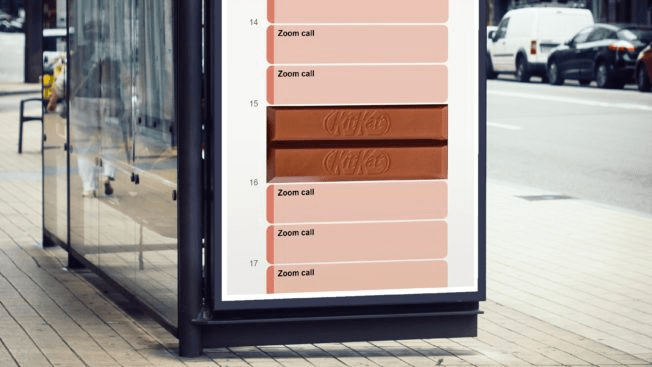
- Write down all product/service benefits

- Write down descriptions of audience
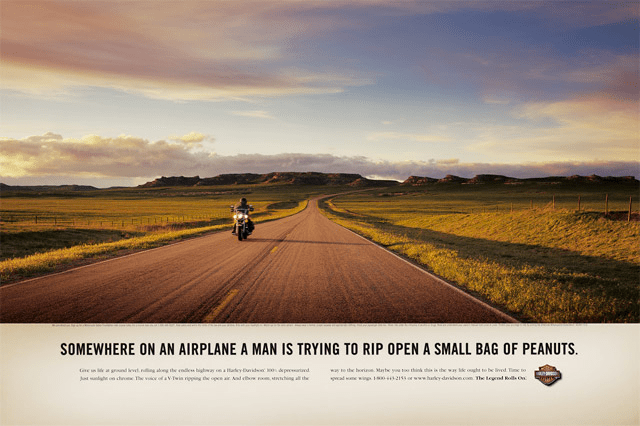
- Write down descriptions of pain points

- Look at other ads from the industry (what makes them appealing or not)
- Look at your “idea folder” and see if any are a good fit for this ad (more on this later – keep an idea folder!)
- What does the logo look like?
- What is the name of the product or company? Are there letters in the name you can play with?
- Go look up creative print ads – even if it’s not relevant to your ad, creative juices start flowing
Step 3 – Walk Away
If Step 1 is collecting the ingredients and Step 2 is preparing the dish, then Step 3 is putting it in the oven and walking away. Sometimes literally.
Go for a walk and really look at the world around you. Notice everything you normally wouldn’t. Do something you enjoy. Or go for a run or bike ride and think – some of my best ideas came from exercising and letting my subconscious take over.
Step 3 can be scary. It can be hard to walk away when you haven’t come up with The Idea yet. While Step 2 can be intense, you reach a point where it’s best to take a break.
One other reason why it’s helpful to walk away: You may be going down the wrong path.
Maybe during Step 2 you’ve been trying like crazy to tell the story on how the product is the toughest on the market. Once you get in that mindset, you’re laser focused on “tough.”
Tough, tough, tough…how do we show it’s tough?
You lose sight of alternatives. Instead of tough, maybe we tell the cost-effective story. Or dependable customer service. Or anything else.
Walking away frees you from the mindset of The Idea must be about This – when it could be about That.
(Rock band OK Go makes incredibly elaborate music videos and gave an amazing TED Talk about how they come up with ideas. You should watch it. A huge part of their idea process: changing perspective.)
4 – That’s It!
Sometimes an idea doesn’t come to you during Step 3 – and it’s back to Step 2 and repeating the process. More often than not, though, there is the eureka moment. This is when you rush to the Notes app on your phone or grab a yellow legal pad or scribble on the back of a receipt.
Oftentimes, it’s not a full idea but it’s enough to push you forward with a rush of creativity.
Now comes the fun.
5 – Do Your Thing
Now you ride that wave of creativity. It’s exhilarating and often working with teammates (a designer or another writer) can help perfect the idea. They see something you don’t. They add some other spices. They provide another much-needed perspective.
Whether with a team or solo, now you’re onto something.
Execution of an Ad
Stick with one thought
People love to include as much information as possible in a nice, big print ad. “We want to talk about how the product is tough, about how the product prevents downtime, about how the product is efficient, about how the product…”
No.
Pick one thing (a specific benefit, audience attribute, pain point, etc.) and focus on that.
Practice restraint
This is where thumbing through trade journals and magazines helps. You know which ads tend to stand out? The ones without a lot on the page. The ones with a ton of white space.
As I mentioned about landing pages: less is almost always better.
That’s harder in B2B because brands may not have the same brand recognition as Tide or Nike. But if you need body copy, don’t fill it with fluff. Say what you need to say in as few words as possible.
One of my favorite books – Hey Whipple, Squeeze This – has a valuable exercise: Does this ad still work if I remove this? If so, take it out.
For example: if I remove the last sentence of the body copy, how much does the ad suffer? Not much? Bye.
Your product is boring
Most likely the product looks dull – people aren’t buying the equipment, they’re buying the benefits that come with the equipment. That’s a problem, especially when people love to have the main photo be of the great, big boring product.
Unless the product specifically plays into the concept/hook, create the ad around an image that’s interesting. If you must include a picture of the product, have it be a smaller photo down by the body copy. If you want to show that the product is tough, come up with a visualization of tough.
With a print ad, it’s your job to create something interesting that piques the reader’s curiosity. A huge photo of equipment doesn’t.
Save your ideas
Throughout this process, you probably have a list of other ideas that you didn’t run with. Don’t throw them away. They weren’t right for this product or audience, but there will likely be a time when there’s some meat on the bone of that idea.
My Creative Process:
 copyhound
4 thoughts on “My Creative Process: Print Ads”