
So, you want to create a landing page.
Congratulations, that’s very exciting. Now comes the hard part: how are you going to build this damn thing? There are many ways to structure a nice landing page, but here is the mental checklist I work through:
What are the ingredients?
List out all existing and potential assets that will live on the landing page. For example:
- Brochure
- Spec sheet
- Blogs
- Longform piece
- Videos
- Case studies
Sometimes you’ll have a full spread of delicious ingredients to work with. Sometimes only a few things. And sometimes the ingredients went bad years ago. You’re making the dish, so understand what you have to work with.
What’s the point?
Why does the landing page exist?
What’s the single most important action we want a user to take? Provide their information in a form fill? Look at a “crown jewel” piece of content? Request a quote?
Hell, are we trying to have them go all the way and place an order?
Whether it’s education-driven, sales-driven or outreach-driven, land on a singular mission. If the landing page is a star-studded concert, which action is the headliner?
Once you figure that out, you can start to build from the top down.
Important: Just because one action is the star doesn’t mean you should ignore the others. If we want to drive them to a longform piece, have plenty of ways for them to reach out to an expert. If we want to have them fill out a form, still include information for them to learn more on their own.
How much data do you have?
It’s good to have information that doesn’t send you somewhere else. It doesn’t open a blog. It doesn’t start a video. It’s information that people can read while scanning a page.
Proof statements can be incredible powerful and efficient. Anybody can say “our experienced staff” and “we use high quality materials.” Because anybody can say that, it sucks as copy.
In contrast, proof statements are provable, data-backed reasons for people to believe what you’re saying.

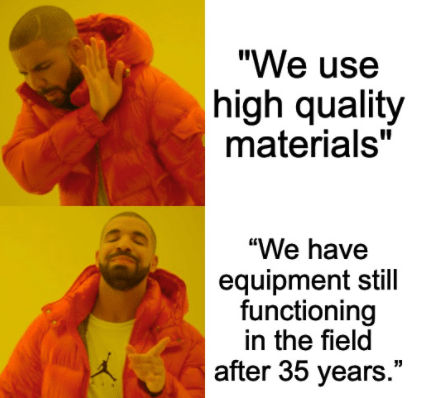
Sometimes these data points already exist. Sometimes the raw data exists and you need to find the common themes. And sometimes you’re flat out of luck.
But always – ALWAYS – ask if the data exists.
What is the biggest problem this page or your client is trying to solve?
One of the hardest parts about marketing is understanding nobody wants to read your pretty words. BUT, words are often necessary for people to understand what they’re looking at.
More than likely, the landing page needs body copy. Remember: less text is almost always better. Be incredibly efficient with your word count. Getting to the point quickly requires you know the biggest challenge or trouble the user is going through.
Why are they interested?
Speak to what they’re going through and do it fast. Say what you need to say in the fewest words possible. I’d take 100 strong, focused words over 400 any day.
Don’t try to sound smart, it’ll only make you sound stupid
Let’s talk word choice. Cut all the business jargon bullcrap that you use to sound smart – and by you, I also mean me. People do that for two reasons:
- It artificially builds out the word count and more words the better, right??
- They are using words they think build credibility.
The irony is this has the exact opposite effect. The more words there are, the less likely somebody will read it. Also, Princeton professor Daniel Oppenheimer’s study Consequences of Erudite Vernacular Utilized Irrespective of Necessity: Problems with Using Long Words Needlessly proved what many writers preach: simple words are better than trying to “sound smart.”
You don’t have much time, so speak clearly and get to the point.
Clear copy, full thoughts, can’t lose
It’s easy to lose control building a landing page.
We’ll include this! And this! And we can’t forget about this! Oh, and we need to find space for this!
It’s okay to have a lot of information on a landing page, but you need a clear-cut hierarchy and flow. White space is your friend. But like overzealous real estate developers, some people see white space as valuable land to add more information – no, no, even MORE information and even MORE CTA buttons!
If you cram too much into a landing page, it starts to look like this:

And no matter how eclectic your style, that’s not good.
Find inspiration elsewhere – even from a makeup company
It’s okay to stay in the same creative design “ballpark” of other companies in your industry. Build something that has cognitive ease, to quote psychologist Daniel Kahneman.
You don’t want to build something so drastically different that your users can’t follow it. They should understand how to navigate your landing page because it feels familiar.
But I’ve also found great inspiration from other industries. For example, if I’m doing a landing page for industrial manufacturing equipment, what creative aspects could I take from a food delivery service or a makeup provider?
There’s nothing new under the sun. Find the best fit for your landing page, wherever the inspiration may come from.
Learn when you’re wrong
There’s nothing better than seeing a designer take your vision and bring it to life. It’s still exciting for me to see a mock-up for the first time.
However, sometimes there’s a disconnect. What you pictured in your head was slightly different than what the designer came up with. It’s a sad reality for us Word People, but most of the time what the designer came up with is better.
You need to learn when to push back because your idea is better – Word People can be very particular – and when you tip your cap and understand they are right.
My Creative Process:
 copyhound
4 thoughts on “My Creative Process: Landing Pages”